


ISPI's Performance Standards
The 10 Performance Standards and the AI4PI Framework provide performance professionals with an evidence-based, systematic process to improve organizational performance.
The 10 Performance Standards
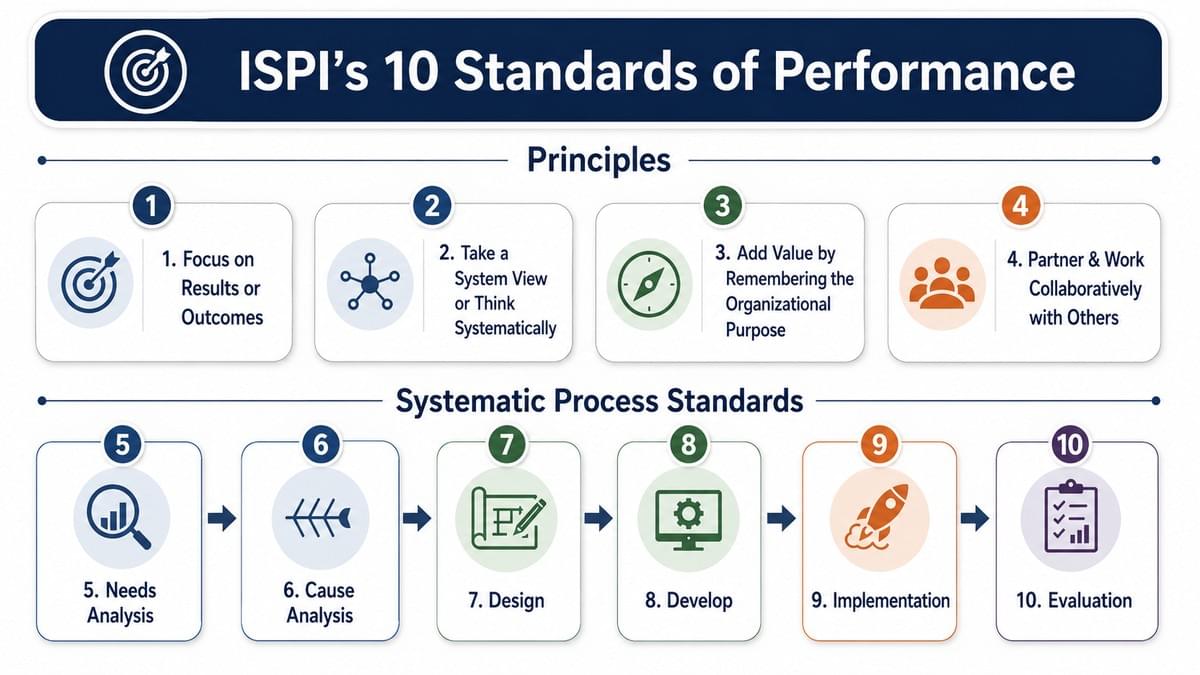
The 10 Performance Standards are universal guiding principles that guide how competent professionals apply the systematic process standards and practices to achieve results.
10 Performance Standards
Competent practitioners follow a systematic process represented by the remaining standards. Select each box below to learn more.
Standard #1 - Focus on Results or Outcomes
Competent practitioners are focused on results throughout their assignments. They are not predisposed to a set of solutions.
They apply their knowledge of what is required for performance at all levels and their consulting and communication skills to:
- Help clients and stakeholders define what they want to accomplish.
- Guide clients in how to convert results into measurable terms.
- Help clients stay focused when unrelated information and needs surface.
- Challenge assumptions to uncover important priorities.
- Facilitate discussions about the worth of a problem in terms of costs, human energy, or risk.
- Help clients weigh the risk of unanticipated outcomes.
So clients:
- Examine the motives behind the request
- Commit the resources to complete the wor
- Acknowledge some ownership for the success of the project.
- Anticipate the changes required to achieve the goals they want.
Examples:
- Ask what needs to be different as a result of the work.
- Identify desired results such as improved profit or net revenue, dollars saved, people employed, production rates increased, task proficiency, compliance with regulations, employee retention, reduced costs, increased customer retention, and so forth.
- Identify what team members and stakeholders require for them to focus on results and provide resources that support them in focusing on results.
- Act as a liaison between all involved and affected to ensure everyone is working toward the same results.
- Decide what questions need to be addressed to help clients comprehend the implications of the work
Standard #2 - Take a Systemic View
Competent practitioners take a systemic view of their work. This requires them to identify the subsystems that make up the total organization. They look for and recognize that a change in one area will affect other areas. They consider how the dynamics in society, the marketplace, workplace, work, and workers affect the desired outcomes.
They use their knowledge of systems theory and their consulting and communication skills to help clients recognize:
- How functions are interdependent.
- That a change in one area or system will affect other systems.
- The relationship between internal practices and the marketplace and society.
- The difference between symptoms and causes.
- The impact of misalignment of goals and practices.
- How decisions and misalignment affect the ability to be competitive in the marketplace.
So clients:
- Make better decisions about the work
- Question the implications of decisions before acting
- Consider others in their decisions.
Examples:
- Introduce team members to systems theory.
- Model a systemic view in your exchanges with the client and key influencers in the organization.
- Have conversations around barriers in the workplace that may affect the project.
- Discuss the importance of knowing:
− The agendas of key political players and stakeholders
− How practices may affect the larger environment
− Constraints or pressures (i.e., budget, scope, resources) of key players, the business, and the target audience
− Expectations around the project
− Consequences of various solutions or risks in not pursuing a solution
− How the work, workplace, or environment supports or impedes the desired organizational and group performance
− How the current culture supports or impedes the desired performanceWhere there is a lack of alignment between or among key factors affecting the success of the solution(s) - How proposed solutions will affect the greater environment of the organization as a whole
Standard #3 - Add Value
Competent practitioners add value by using their expertise to facilitate the process in ways that result in better decisions, higher quality work by their team, and a higher quality end product.
They:
- Ensure that the project team considers an appropriate range of solutions and the implications before taking action.
- Help clients and stakeholders compare factors such as:
− Cost to design, develop, implement, and maintain or sustain each solution
− Risks and costs associated with the proposed solutions - Help clients to discuss and understand the:
− Likelihood of adoption of new behaviors
− Probability of achieving the desired goals
− Implication or possible impact on stakeholders
− Ability of the organization to sustain the solution - Display honesty, respectfully push back, challenge assumptions.
- Represent themselves honestly, not as having expertise beyond their capabilities.
- Effectively manage time and resources in their area(s) of responsibility.
So clients:
- Appreciate the importance and value of the work and the consultant’s role in the work.
- Conclude that they received greater value from their investment than expected.
Examples:
- Point out the goal of the solution is to:
− Bring new hires to proficiency faster
− Satisfy regulations
− Satisfy an organizational need or opportunity - Present facts related to the request and point out the costs, risks, and odds of success, such as the following:
− Lack of field support
− Lack of technological infrastructure
− Significant change in culture
− Lack of incentive or consequence for using the solution - Point out what other interventions may be required to fully realize the opportunity or satisfy the need.
- Guide the client or team in choosing the solution with the best value added.
- Find out where the pain is or where the opportunities lie for the organization or key clients.
- Facilitate discussions on how to best relieve the pain or seize the opportunity.
- Challenge ideas that are based on faulty assumptions.
- Provide solutions that are aligned with the organization’s goals and capability to actualize.
- Help people get jobs and keep jobs.
- Help clients see how to use a particular solution in a new way.
Standard #4 - Work in Partnership with Clients and Stakeholders
Competent practitioners collaborate with clients and stakeholders.
They:- Involve the client and all stakeholders in the decision making around every phase of the process.
- Engage specialists as needed.
- Listen closely to their client.
- Gain their client’s trust and respect.
- Are honest with clients.
- Build partnerships.
- Ensure the voices of all vested stakeholders are sought and integrated into the design of the solution.
- Give credit to everyone who contributes to the project.
- Foster open communication within and between groups.
So clients:
Share responsibility for the success of the project.
Make the best choices about accomplishments, priorities, and solutions.
Meet their needs in a sustainable way.
Examples:
Make sure there is a program sponsor or champion.
Negotiate the sponsor’s level of involvement.
Establish relationships with political leaders who may affect stakeholders of the project.
- Establish appropriate relationships with individuals, governments, community leaders, and stakeholders to ensure:
- Access to their information, data, or assistance
- Their knowledge is brought to bear
- Their needs are satisfied
- A solid business case for change or the recommended solution.
- The required support when it comes time for implementation
- Engage other functions in ways that are mutually beneficial.
- Recommend specialists outside of your expertise (for example, human factors and interior designers to help redesign work space and tools, and so forth).
- Draw on the expertise of specialists who can contribute to the development of strategy, materials, or delivery mechanisms.
Standard #5 - Determine Need or Opportunity
Competent practitioners design and conduct investigations to find out the difference between the current and the desired performances (the performance gap).
They:
- Facilitate discussions with clients to clarify intent of the investigation.
- Determine the scope of the investigation.
- Choose the appropriate method of analysis.
- Decide on how to best get the data.
- Gather the data.
- Analyze the data.
- Determine the magnitude of the gap.
- Report the finding with recommendations.
- Interpret the findings for the client.
So clients can make informed decisions and set priorities about what actions to take.
Examples:
In collaboration with your client, you might:
- Identify the objectives of the analysis, who to involve, what data you require, how best to get the data, how to best use the data, who will use the data, and when you want to begin and end.
- Interview stakeholders, observe job processes, and examine existing documentation.
- Determine which needs or opportunities are worth pursuing further.
Real World Example:
- IBM conducted acomprehensive skills gap analysis in 2019 to address the rapidly changing
technology landscape. - They clarified the intent with HR and various department heads globally.
- The scope included all technical roles across the company.
- They used skills assessments, manager interviews, and industry trend analysis.
- Data gathering included current skill levels and projected industry needs.
- Analysis revealed significant gaps in AI, cloud computing, and cybersecurity skills.
- IBM reported findings and subsequently launched their "New Collar" jobs initiative and expanded their apprenticeship programs.
Alignment with ISPI Standard #5
Facilitation of Discussions: IBM likely engaged with executives, HR leaders, and department heads to clarify the intent of the investigation, focusing on future skill needs and current capabilities.
Scope Determination: The analysis covered technical roles across the company globally, with a focus on emerging technologies like AI, cloud computing, and cybersecurity.
Analysis Method: IBM used a mixed-method approach, combining quantitative skills assessments with qualitative interviews and industry trend analysis.
Data Gathering:
- Conducted skills assessments across technical roles
- Interviewed managers and technical leaders
- Analyzed industry trends and future technology projections
- Reviewed current training programs and their effectiveness.
Data Analysis: IBM likely used advanced analytics to identify patterns in skills gaps across different roles, departments, and regions.
Gap Magnitude Determination: The analysis revealed significant gaps in AI, cloud computing, and cybersecurity skills, with specific metrics on the percentage of employees needing upskilling in these areas.
Reporting and Recommendations: IBM reported findings to leadership and recommended the
launch of their "New Collar" jobs initiative and the expansion of their apprenticeship programs.Interpretation for Client: In this case, the "client" was IBM's own leadership. The findings
were likely presented in the context of business impact, competitive advantage, and future readiness.Standard #6 - Determine Cause
Competent practitioners design and conduct investigations to find out why a gap exists between the current and desired performances. They look for the underlying causes.
They:
- Consider at least three of the following factors in their investigation:− Social and cultural (World) factors− Marketplace (World) factors− Workplace factors− Work factors− Worker factors
- Choose the appropriate method of analysis.
- Decide on how to best get the data.
- Gather the data.
- Analyze the data.
- Determine the underlying causes.
- Report the findings with recommendations.
- Facilitate discussions with clients to understand the contributing causes.
- Interpret the findings for the client.
So clients are offered an appropriate combination of solutions that collectively will reduce or eliminate the gap between the current and desired performances.
Examples:
In collaboration with your client, you might identify performance deficiencies due to:
- Lack of knowledge and skill.
- Inadequate or insufficient job design, feedback, or performance support systems.
- Established culture and group norms.
Standard #7 - Design Solutions including Implementation and Evaluation
Competent practitioners design solutions and the plan to implement them. Their designs describe each solution’s:
- Features, attributes, and elements.
- Feasibility.
- Alignment to the identified factors.
- Expected improvements to performance.
Their plans include:
- Timing and schedules.
- Resources required.
- Recommendations on how to sustain the improvements.
- Methods to monitor improvements.
So clients:
- Comprehend the implication of implementing the solutions.
- Make the appropriate resource commitments for the next steps.
- Commit to what is required to sustain the expected improvements.
Examples:
For example, you might develop a plan for how you intend to:
- Redesign a process, job, or system.
- Change management practices.
- Change which behaviors and results get rewarded.
- Develop, produce, deploy, and maintain instructional materials.
Standard #8 - Ensure Solutions’ Conformity and Feasibility
Competent practitioners oversee the development of the solutions. They may develop some or all of the solutions or be a member of the development team.
They:
- Compare the solution elements to the design specifications.
- Make sure solution elements are developmentally tested.
- Make sure the solutions are feasible and work as intended.
- Arrange to pilot test the overall solution.
- Oversee improvements and changes based on the results of the tests.
So clients reap the benefits because the solutions that are developed comply with the design.
Examples:
For example, you might:
- Address logistics
- Address support issues
- Pilot test your solution with actual users.
- Make sure materials match the specifications.
Standard #9 - Implement Solutions
Competent practitioners develop strategies that allow clients to sustain change.
They:- Develop messages that clients can use to communicate what is being done, why, and when.
- Develop tools and feedback mechanisms so people can monitor their own progress.
- Draft messages clients can use to report progress.
- Facilitate discussion on how to address deviations from the plan.
- Advise clients how to manage changes in practices so gains are sustained.
So clients:
- Accept responsibility for the success of the change.
- Can communicate progress to stakeholders.
- Reap the full benefit because the solutions were implemented with fidelity.
Examples:
For example, you might:
- Help develop implementation materials and messages.
- Provide input on how to sustain practices.
- Train people who will deliver the solution.
- Assist the target audience in adopting the new behaviors or using new tools.
Standard #10 - Evaluate Results and Measure Impact
Competent practitioners help clients measure the impact of the solutions.
They:- Help the clients select the appropriate measures.
- Develop a measurement strategy that includes ways to:
− Leverage data already being collected
− Collect data
− Analyze the data
− Summarize and report data - Help develop measurement tools and methods.
- Explain the implications of the data.
- Facilitate discussions on what the data mean and how to best use the data.
So clients:
- Understand the results they received from implementing the solutions.
- Recognize what else needs to be done to sustain the results.
- Support the changes necessary to sustain results.
Examples:
For example, you might:- Partner with clients to capture and track performance data.
- Evaluate the results by comparing what you find to some standard, goal, or stakeholder expectation.
- Model the importance of evaluation by measuring the effectiveness of your own methods and processes.
- Coach clients on how to:
− Use sampling methods
− Design data-gathering instruments
− Capture and report data
− Interpret data
The AI4PI Framework
The AI4PI Framework equips professionals to integrate AI responsibly into performance improvement practice. It helps professionals design, implement, and evaluate ethical, human-centered AI solutions that enhance organizational results.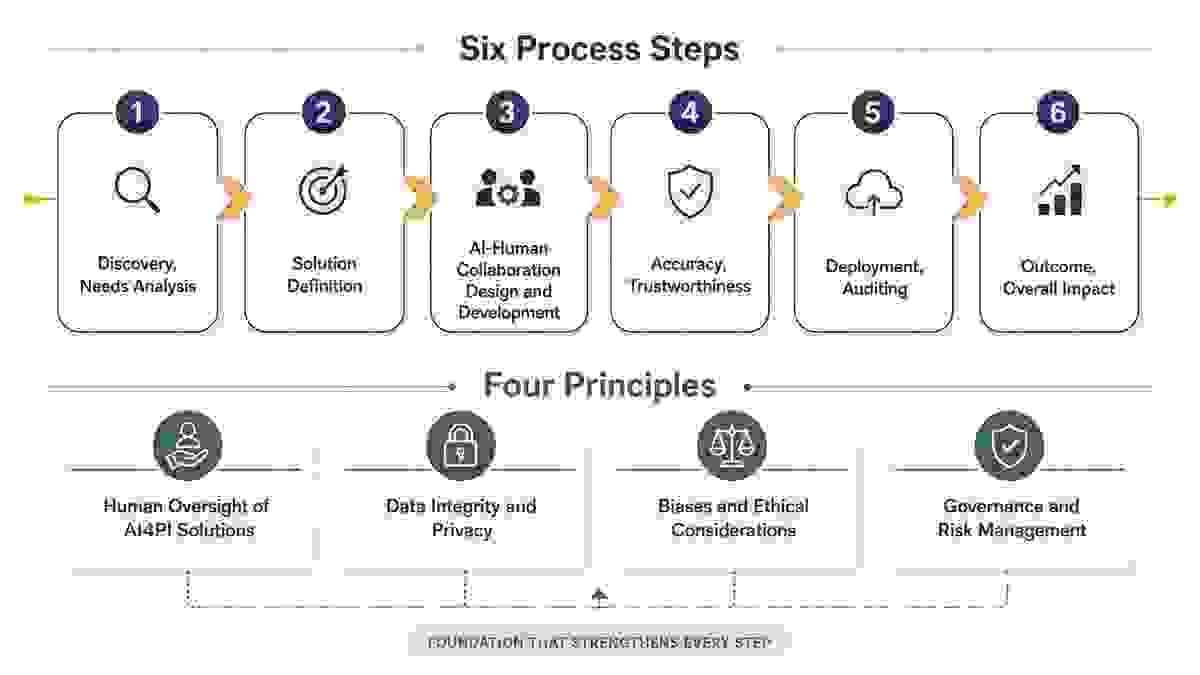
The AI4PI Framework
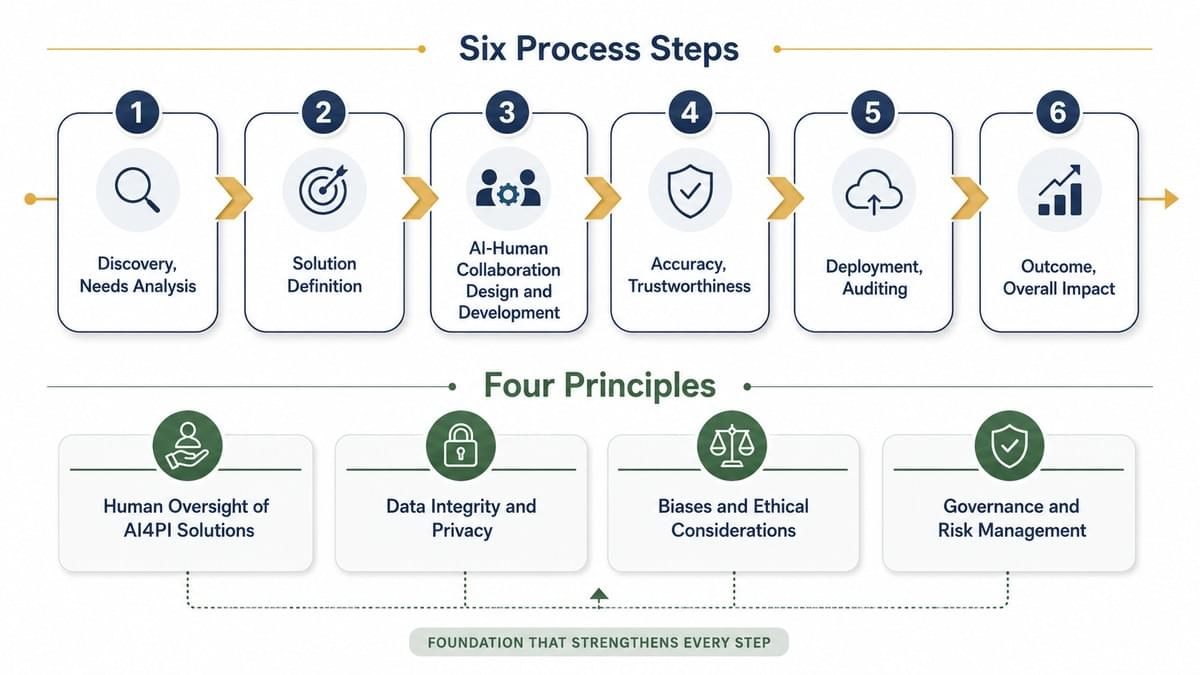
The AI4PI Framework is built on four guiding principles that ensure AI-driven solutions remain human-centered, ethical, and effective. These principles safeguard against risks and foster alignment between technology and human values.
The framework doesn't stop at principles. It offers six actionable steps to guide practitioners through every stage of AI implementation.
Each step ensures that AI adoption is strategic, impactful, and sustainable.
Principle 1: Human Oversight of AI4PI Solutions
Ensure Human Oversight: Maintain transparency, accountability, and human control over AI decisions.
Principle 2: Data Integrity and Privacy
Enforce Data Integrity and Privacy: Protect data at every stage, ensuring confidentiality and trustworthiness.
Principle 3: Biases and Ethical Considerations
Evaluate and Minimize AI Bias: Proactively identify and mitigate biases to promote fairness and equity.
Principle 4: Governance and Risk Management
Establish Governance and Risk Management: Implement robust strategies to manage risks and align AI solutions with organizational goals.
Process Step 1: Discovery and Needs Analysis
Determine the Need and Readiness: Assess organizational preparedness and identify high-impact AI applications.
Process Step 2: Solution Definition
Design Human-Centered Solutions: Craft tailored, efficient, and effective AI interventions.
Process Step 3: AI-Human Collaboration Design and Development
Develop AI-Human Interactions: Ensure intuitive interfaces and seamless collaboration between AI systems and users.
Process Step 4: Accuracy and Trustworthiness
Document Accuracy and Trustworthiness: Validate AI outputs to build confidence and reliability.
Process Step 5: Deployment and Auditing
Deploy and Audit Solutions: Continuously monitor performance and adherence to ethical standards.
Process Step 6: Outcome and Overall Impact
Demonstrate Results: Highlight tangible improvements in performance and return on investment.
ISPI's Performance Standards in action.
ISPI is a 501(c)(3) nonprofit organization. All donations are tax-deductible to the extent permitted by law. EIN: 52-1080922
International Society for Performance Improvement © 2026