

by Dr. Lynne MacBain, CAIT, CPT
Renaissance.
Robert Feeney used the word in his keynote in Nashville. Attendees used it unprompted in their feedback. And the more I have sat with it, the more I believe it is not just an accurate description of where ISPI stands right now. It is the right frame for where we are going.
I did not choose the word because it sounds impressive. I chose it because it is honest.
A Renaissance is not an invention. It is a rediscovery. It is what happens when a community looks at what it already possesses and makes the deliberate choice to put it fully to work.
That is where ISPI stands right now.
Why a Renaissance? Why Now?
The energy in Nashville was hard to miss. Nearly 170 practitioners were in the room, with more joining virtually. People were not just sitting in sessions. They were talking in the hallways, staying late, asking questions, and leaning in.
What I felt in Nashville was a profession rediscovering its identity.
We know who we are. We know what we do that no one else does.
The question is whether we are willing to act like it.
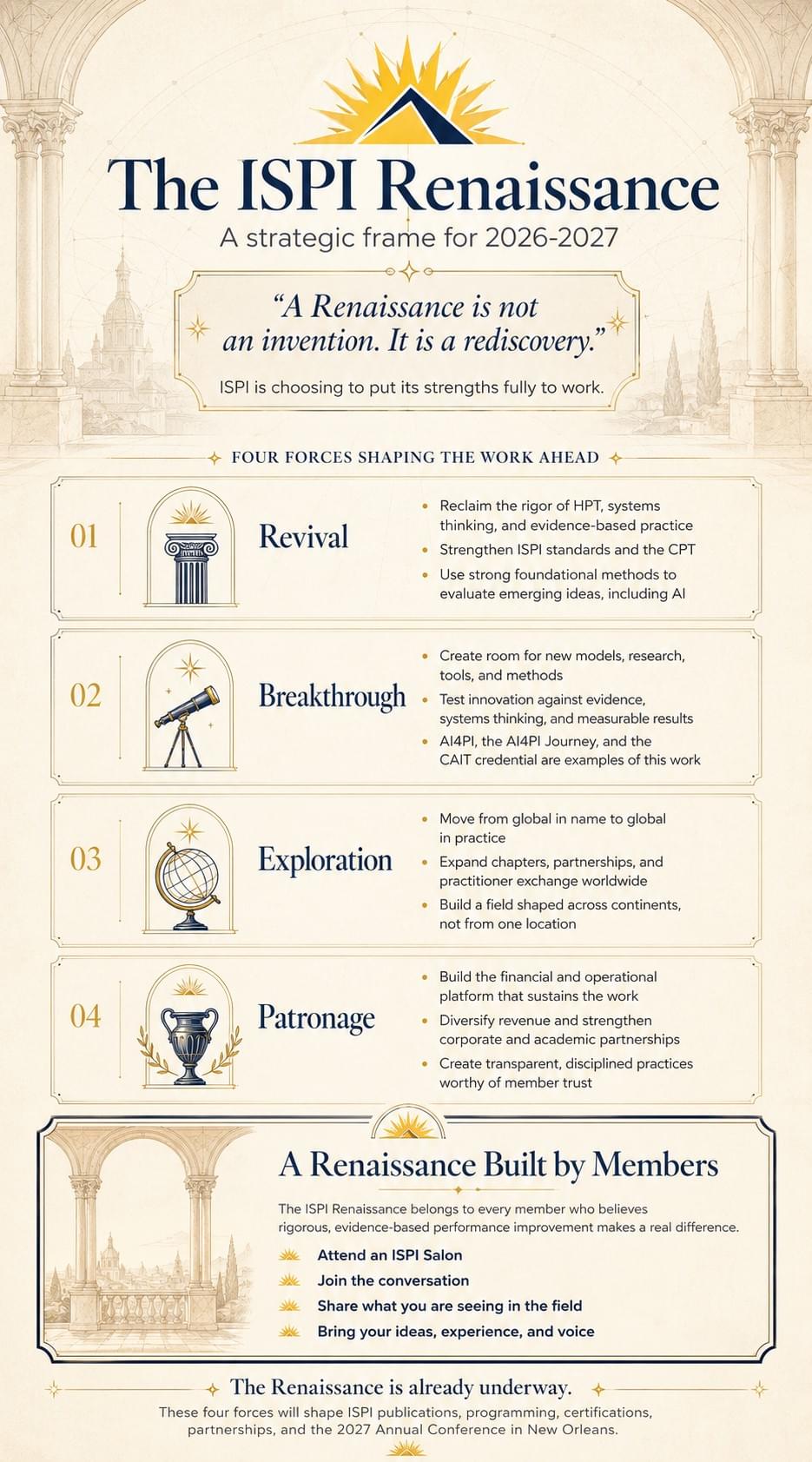
The ISPI Renaissance is not a slogan. It is a strategic frame for 2026-2027, built around four forces already shaping our work: Revival, Breakthrough, Exploration, and Patronage.
Revival
The historical Renaissance began with scholars returning to classical texts. Not because the past was better, but because foundational thinking became more relevant, not less, in a rapidly changing world.
ISPI’s Revival is the same kind of move.
Our methodology is not a legacy concept. It is one of the most rigorous frameworks available for evaluating anything new, including AI. Systems thinking, evidence-based practice, and human performance technology are not relics. They are our differentiator.
In a market saturated with fleeting management trends, holding the line on performance improvement standards is not a conservative choice. It is a radical one.
The CPT matters. The standards matter. What we know about how human performance improves in systems is not optional, and it is not negotiable.
Revival means we invest in that foundation with the seriousness it deserves.
Breakthrough
Breakthrough is about creating room for new thinking in performance improvement.
ISPI’s future cannot depend only on preserving what has already been built. Revival matters because our foundation is strong. But a strong foundation is not meant to become a museum. It is meant to support new models, new frameworks, new research, new applications, and new ways of solving performance problems in a changing world.
That is where ISPI has an important role to play.
We should be the place where serious ideas in performance improvement are developed, challenged, refined, and shared. We should be where practitioners can explore emerging approaches without abandoning rigor. We should be where innovation is tested against evidence, systems thinking, and measurable results.
AI4PI is one example of that breakthrough work. As organizations rush to adopt AI, ISPI is asking the question that matters most: Does this actually improve human performance? Through the AI4PI Framework, AI4PI Journey, and CAIT credential, we are helping practitioners evaluate, design, and implement AI-enabled solutions with discipline and purpose.
But Breakthrough is bigger than AI.
It includes new models, updated frameworks, applied research, stronger tools, better methods, and fresh ways of helping people and systems perform. Breakthrough means ISPI is not only protecting the standards of the field. We are helping shape what comes next.
Exploration
ISPI has always been global in name. Exploration means becoming global in practice.
In Nashville, we signed a landmark collaboration agreement with Sinotrac in China, live on stage. We welcomed new chapters in Switzerland and Africa. Practitioners from across the world were part of the conversation.
That is not a coincidence. That is a direction.
Performance improvement is a universal discipline. It belongs to practitioners in Johannesburg, Beijing, Geneva, Buenos Aires, and everywhere in between. The future of this field will be written on every continent.
ISPI intends to be part of writing it.
Patronage
The historical Renaissance did not sustain itself. It required people and institutions willing to invest in the work.
The same is true here.
Great ideas require a stable platform. Patronage is about building the financial and operational infrastructure that allows the other three forces to last beyond one conference, one board term, or one initiative.
That means diversifying revenue. It means building stronger corporate and academic partnerships. It means creating a certification ecosystem that generates growth and reinvests in the Society. And it means financial practices that are transparent, disciplined, and worthy of member trust.
We are building something that should outlast every single person currently serving this organization.
That deserves to be resourced like it.
A Renaissance Built by Members
The ISPI Renaissance does not belong to the board.
It does not belong to the president.
It belongs to every member who believes that performance improvement, done with rigor and evidence, makes a real difference in people’s lives.
This year is not about managing a list of initiatives. It is about leading a Renaissance.
These four forces will show up in our publications, programming, certifications, partnerships, member conversations, and in our 2027 Annual Conference in New Orleans, a city that knows what renaissance looks like.
But the Renaissance only works if members help shape it.
Attend an ISPI Salon. Join the conversation. Ask honest questions. Share what you are seeing in the field. Bring your ideas, your experience, and your voice.
The Renaissance is already underway.
I am glad to be in it with you.
Are you building for today’s trends, or are you building a framework that will outlast you?
Lynne MacBain, EdD, CPT, CAIT is President of the International Society for Performance Improvement (ISPI) and CEO of PivotPoint Strategies.